
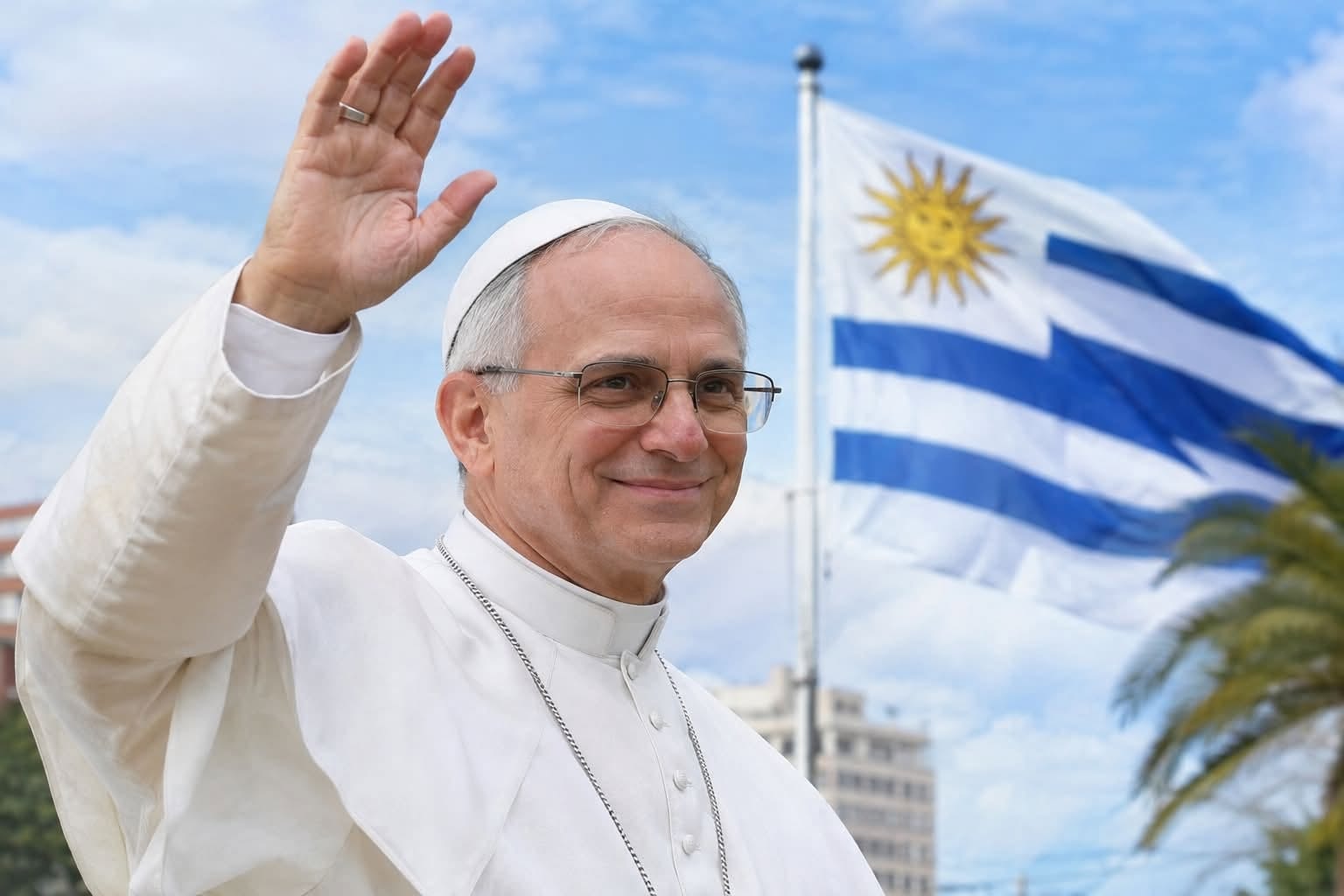
Pope Leo XIV’s Historic Visit to Uruguay Brings a Message of Faith, Hope and Unity to One of Latin America’s Most Secular Nations
Uruguay prepares for its first papal visit in 38 years as Pope Leo XIV arrives with a message of faith, solidarity and human dignity.
Uruguay is preparing for a historic moment as Pope Leo XIV arrives today, November 6, marking the first papal journey to the country in 38 years. His arrival represents more than a religious occasion. It offers an opportunity for reflection on faith, human dignity, solidarity and the importance of bringing people together in a nation where organized religion plays a relatively limited role in everyday life.
Uruguay has long been recognized as one of the most secular countries in Latin America. Unlike many of its neighbors, where Catholic traditions remain deeply embedded in public life, Uruguay has developed a national identity shaped by the separation of church and state, freedom of conscience and a strong tradition of secular government.
According to Vatican News, Catholics represent approximately 36 percent of Uruguay’s population, one of the lowest proportions in Latin America. Many Uruguayans do not regularly attend religious services, while others identify as atheist, agnostic or unaffiliated with organized religion.
Yet religious participation does not necessarily define a society’s moral values, compassion or capacity for spiritual reflection.
This is what makes the Pope’s visit particularly meaningful.
A Historic Return After Nearly Four Decades
The last papal visit to Uruguay took place in 1988, when Pope John Paul II visited the country. Now, nearly four decades later, Pope Leo XIV will return the Vatican’s presence to a society that has continued to evolve culturally, socially and politically.
The official itinerary includes Montevideo, Paysandú and Florida, with religious celebrations, meetings with government authorities and encounters with local communities.
Today, November 6, Pope Leo XIV is scheduled to arrive at Carrasco International Airport before attending an official welcoming ceremony in Montevideo’s Plaza Independencia. He will also meet with President Yamandú Orsi.
On November 7, the pontiff will celebrate Mass in Paysandú before returning to Montevideo for meetings with the Casavalle community and representatives of the education sector. A prayer vigil is scheduled at the historic Centenario Stadium.
His visit will conclude on November 8 with Mass in Florida, home to the National Shrine of Our Lady of the Thirty Three, before he departs for Argentina.
The itinerary reflects an effort to connect with different communities rather than limiting the visit to official ceremonies.
Why Uruguay’s Secular Identity Makes This Visit Significant
Uruguay’s relationship with religion is distinctive. The country’s secular tradition was consolidated through constitutional reforms in the early twentieth century, including the formal separation of church and state under the Constitution that took effect in 1919.
Even the names of certain holidays reflect this cultural identity. Holy Week is officially recognized as Tourism Week, while Christmas is designated as Family Day in the country’s civic calendar.
For generations, many Uruguayans have grown up in an environment where religion is considered a personal choice rather than a central feature of public life.
However, secularism should not be confused with an absence of spirituality or moral principles. A person does not need to attend church to value kindness, honesty, forgiveness or compassion. Likewise, someone who does not believe in God can still recognize the importance of messages that encourage peace, respect and concern for others.
The Pope’s visit presents an opportunity to explore that common ground.
A Message That Extends Beyond Religious Beliefs
For millions of Catholics around the world, the Pope represents spiritual leadership and the teachings of the Church. But the messages delivered during a papal visit can also reach audiences who do not share the Catholic faith.
In societies increasingly challenged by political polarization, economic pressures, loneliness and social division, conversations about human dignity and compassion remain relevant.
The value of such a message does not necessarily depend on whether it changes someone’s religious beliefs. It may instead encourage individuals to reflect on how they treat others, how communities support vulnerable families and how people with different convictions can coexist peacefully.
A call for solidarity can resonate with believers and nonbelievers alike. A message about forgiveness can speak to those carrying personal pain. And an appeal for peace can offer common ground in a world frequently divided by political and cultural differences.
During a Vatican briefing on November 3, the secular character of Uruguay became a subject of discussion. Maria Montserrat Alvarado, prefect of the Dicastery for Communication, responded to questions about why the Pope would visit such a secular nation by emphasizing that the Gospel is intended to reach everywhere.
That perspective highlights the broader purpose of the journey: bringing a religious message beyond the walls of churches and into communities with different experiences and beliefs.
Reaching Communities Beyond the Church
One of the most meaningful moments of the Pope’s itinerary may be his scheduled visit to Casavalle, a community in Montevideo that has faced longstanding social and economic challenges. The encounter places attention on people whose daily struggles may otherwise receive limited public recognition.
It also reflects an important dimension of the Church’s social mission: reaching those who experience poverty, exclusion or hardship. Behind every statistic about economic inequality are families, children, older adults and individuals seeking opportunities, stability and dignity.
A visit by a global religious leader cannot resolve these challenges on its own. However, it can bring attention to communities whose needs deserve continued public discussion and meaningful action.
The lasting value of such an encounter will depend not only on the words spoken but also on whether the attention it generates encourages greater solidarity and lasting commitments.
Faith, Freedom and Respect Can Coexist
The arrival of Pope Leo XIV does not mean Uruguay must reconsider its secular identity. On the contrary, welcoming a religious leader while maintaining freedom of conscience can demonstrate the strength of a democratic society.
Secularism protects the right to believe, the right not to believe and the right to practice religion without government interference or preference. Those principles are not incompatible with recognizing the cultural, diplomatic and spiritual significance of a papal visit.
Uruguay can remain firmly committed to its secular traditions while opening its doors to a message of peace and human fraternity. For some citizens, the visit may strengthen their faith. For others, it may inspire curiosity, reflection or simply an appreciation of its historical significance. Others may choose not to participate, a decision equally deserving of respect.
An Opportunity for Reflection and Hope
Perhaps the most important question is not whether the Pope’s visit will increase religious participation in Uruguay. The deeper question is whether it can encourage a broader conversation about the values that hold a society together.
Can people with different beliefs listen to one another with greater understanding? Can communities become more attentive to those experiencing hardship? Can messages of compassion and solidarity inspire action beyond religious institutions?
These are questions that extend far beyond Catholicism. Uruguay’s secular identity is an important part of its history, but so too are the values of human dignity, freedom and mutual respect.
The arrival of Pope Leo XIV offers a moment to reflect on how those principles can coexist with spiritual expression.
Ultimately, the significance of this historic visit may not be measured solely by the crowds attending Mass or the number of people participating in religious celebrations. Its meaning may also be found in the conversations it inspires, the communities it brings into focus and the reminder that humanity shares fundamental needs regardless of religious affiliation.
People of every belief experience suffering, loss, uncertainty and the need for hope. And in a world where differences too often become sources of division, a message encouraging compassion, peace and respect can have value far beyond the boundaries of any one faith.
For Uruguay, the visit of Pope Leo XIV represents more than the return of a Catholic leader after 38 years. It is an opportunity to demonstrate that a secular nation can welcome a spiritual message without compromising its identity, and that faith and freedom, when grounded in mutual respect, can coexist in a society that values the dignity of every individual.
Sources
- Vatican Press Office — Official Apostolic Journey Programme, September 21, 2026
- Vatican News — Pope Leo XIV’s Journey to Latin America, August 5 and November 3, 2026
- Presidency of Uruguay — Official Announcement of the Papal Visit, August 5, 2026
- Ministry of Foreign Affairs of Uruguay — Official Visit Agenda, September 21, 2026