
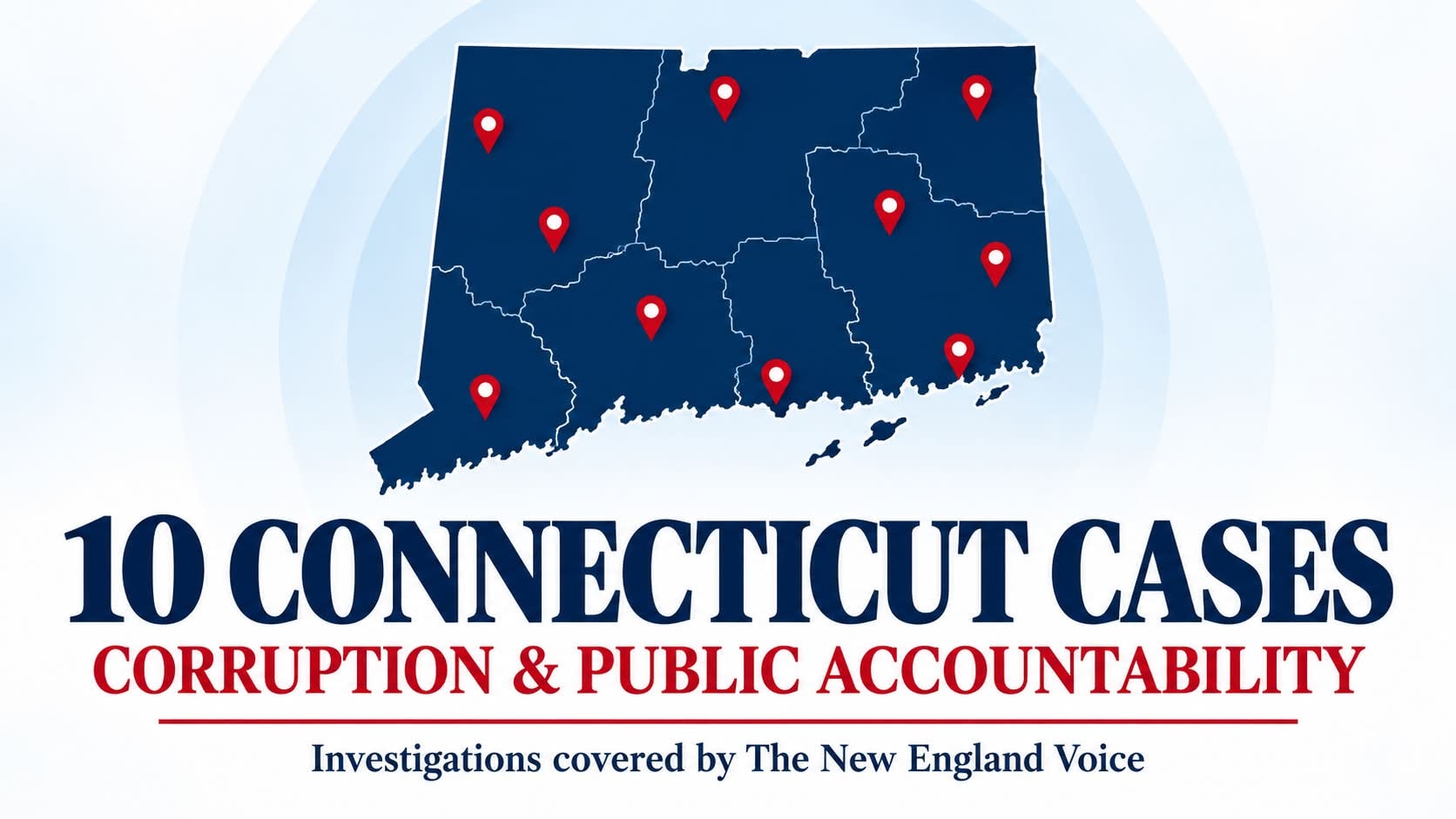
Connecticut's Corruption Cases and Public-Accountability Questions
A federal corruption conviction, criminal charges, workplace findings, audit concerns and disputed contracts are testing public trust across the state
By Isabel Calione
· The New England Voice
Connecticut's recent headlines include a senior state official convicted of corruption, criminal charges that have not been proved, workplace investigations, audit findings and disputes over public contracts and utility costs.
These matters are not all the same, and not every oversight failure or controversial decision is corruption. Together, however, they raise a question residents have a right to ask: Are public officials and institutions being held accountable when public trust is damaged?
Kosta Diamantis: conviction and sentence
Former state budget official Konstantinos "Kosta" Diamantis was convicted by a federal jury on 21 counts involving bribery, extortion, conspiracy and false statements tied to school-construction work.
After he failed to appear for sentencing and traveled to Greece, a federal judge sentenced him in absentia to seven years in prison. He also faces a separate federal case that has been postponed until 2027.
This is the clearest criminal-corruption conviction among the cases reviewed here.
Bridgeport absentee-ballot charges
Former state Sen. Dennis Bradley was arrested and charged in October in connection with alleged interference with an absentee ballot during Bridgeport's August 2026 Democratic primary.
Prosecutors allege that he handled ballots improperly and told a voter to change her vote in a probate-judge contest involving his brother.
The allegations have not been proved in court, and Bradley is presumed innocent.
Hartford: Carmen Sierra workplace report
An independent workplace investigation found that former Hartford Treasurer Carmen Sierra violated the city's anti-harassment policy through comments related to marital status, age and ethnicity.
The report also found that her conduct discouraged employees from challenging changes to compensatory time or requesting time off because they feared retaliation.
Sierra denied some of the statements attributed to her, and the investigator did not uphold every allegation. This is a workplace misconduct finding, not by itself a finding of financial corruption.
Complaints at the Connecticut Department of Banking
Current and former employees have reported bullying, intimidation and retaliation involving the agency's leadership. Commissioner Jorge Perez has denied the accusations.
Separately, an investigation found that manager Alvaro Santamaria engaged in sexual harassment and other misconduct, resulting in a 10-day unpaid suspension.
Questions remain about how employee complaints were reviewed and what protections followed. The allegations against Commissioner Perez should not be presented as established findings.
A $250,000 no-bid contract for Miguel Cardona's firm
The state awarded Cardona Solutions, owned by former U.S. Education Secretary Miguel Cardona, a contract worth up to $250,000 to support the Career Pathways Commission, which Cardona chairs.
Gov. Ned Lamont said he knew of and approved the arrangement. The state cited a tight deadline and Cardona's experience, while the Office of State Ethics said the arrangement did not appear to violate the ethics code.
Critics have questioned the lack of competitive bidding and the fact that the commission was initially described as unpaid. The public concern centers on transparency and the appearance of favoritism; available reporting does not establish an ethics violation.
Meriden and Groton housing-authority loan case
Federal prosecutors charged former housing-authority director Robert Cappelletti in an alleged $16.2 million loan scheme.
Prosecutors say he used unauthorized board documents to obtain the loan, directed some proceeds toward personal expenses and directed payments from Groton Housing Authority funds.
Cappelletti pleaded not guilty. The allegations will be tested in court.
WestConn audit findings
Connecticut's Auditors of Public Accounts found that Western Connecticut State University lacked a fully executed contract for portions of two fiscal years tied to a $6.38 million service agreement.
The audit also identified weaknesses in purchasing approvals and documentation. The university agreed with the procurement finding and outlined corrective steps.
The audit did not say that the $6.38 million was stolen or improperly spent; it identified control and contracting failures.
Eversource storm-cost appeal
Eversource appealed a state regulatory decision rejecting more than $300 million in interest associated with past storm costs.
Regulators had approved substantial storm-cost recovery but disputed when financing charges could begin and which expenses qualified. The Attorney General raised concerns about contractor costs and documentation.
This is a regulatory dispute over utility cost recovery, not a criminal-corruption finding.
Aquarion's sale and future water bills
Aquarion Water Company's $2.4 billion sale to a nonprofit water authority was completed after approval by state regulators.
Attorney General William Tong warned that customers could ultimately pay principal and interest associated with the acquisition through future water rates. The authority and utility disputed claims that the sale itself would drive rate increases.
This is a contested policy and consumer-cost issue, not a corruption case.
The broader question of public-money oversight
Connecticut's large streams of state, municipal and federal pandemic-era spending have prompted questions about who checks how the money is used.
Audits can identify weak controls, improper procedures or questionable expenses, but an audit finding alone does not prove a crime. Investigations, charges and convictions are different stages and must be described accurately.
Accountability requires clear answers
These cases range from a corruption conviction and pending criminal charges to workplace findings, procurement weaknesses and regulatory disputes. Treating them all as proven corruption would blur important facts. But dismissing them as unrelated would also miss the public concern they share: people need to know how decisions were made, who reviewed them, what consequences followed and whether public safeguards worked.
Public trust depends on more than promises of transparency. It requires timely records, independent oversight, fair investigations and clear explanations from the institutions involved. Connecticut residents deserve answers, and the facts in each case should be followed through to their legal or administrative conclusion.
The cases described here span years and involve different agencies, different levels of government, and different kinds of alleged wrongdoing. What connects them is that public money, public trust, or public processes were at stake.
Accountability is not a single event. It is a continuing obligation — one that belongs to officials, institutions, and the public alike.
Reporting notes
This roundup distinguishes convictions and formal findings from allegations, pending cases, audits and regulatory disputes. The legal status of pending matters may change; check the latest court and agency records before publication.
Source articles
- Eversource storm-cost interest appeal
- Bradley absentee-ballot arrest
- Carmen Sierra and Hartford's public explanation
- Kosta Diamantis sentencing
- Connecticut banking workplace complaints
- Connecticut public-money oversight
- Miguel Cardona no-bid contract
- Aquarion water sale
- Meriden and Groton housing-authority case
- WestConn audit-contract lapse
Isabel Calione
Founder and editor of The New England Voice. Isabel covers Connecticut politics, accountability, and community affairs.