
Who Is Watching Connecticut Drivers? Inside the Growing Network of License Plate Cameras
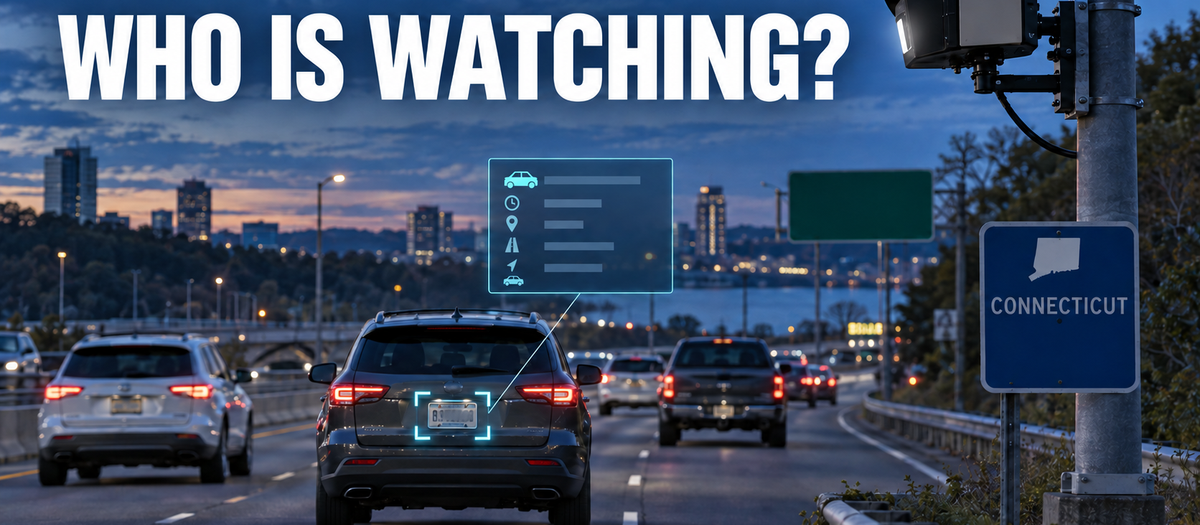
CONNECTICUT — Cameras positioned along roads and in parking lots are recording license plates and vehicle information as drivers travel through Connecticut. Many residents may pass these devices without knowing who operates them, what information they collect or how that information can be searched.
Many of these devices are Automated License Plate Readers, commonly known as ALPRs. A major provider is Flock Safety, a private technology company that supplies cameras and software to police departments, municipal governments, businesses, schools, apartment communities, houses of worship and neighborhood associations.
These are not usually federal cameras. Most are operated by local police departments, municipal agencies or private organizations. However, questions have emerged about whether information collected locally can be searched or shared beyond the community where a camera is installed.
The cameras capture images of passing vehicles and use software to identify license plate numbers. Depending on the system, they may also record the date, time, location, direction of travel and vehicle characteristics such as color, type and distinctive features.
Flock Safety says its license plate readers do not use facial recognition technology. The cameras are designed to identify vehicles, not the people driving them.
These cameras are also different from speed and red light cameras. Automated traffic enforcement cameras are used to document specific traffic violations and may produce fines. License plate readers are generally used as investigative tools. They may alert police when a plate is connected to a stolen vehicle, a missing person, an Amber Alert or another law enforcement investigation.
Police departments say this technology can help investigators locate vehicles more quickly, recover stolen cars, find missing people and develop leads in serious criminal cases. A camera may record a vehicle connected to an investigation even when no officer is present at that location.
The technology also records vehicles that are not associated with criminal activity. Every vehicle passing a camera may be scanned, creating concerns about how much information is collected about ordinary drivers and how long it remains searchable.
Mapping the Network
An independent website called DeFlock is attempting to make the camera network more visible to the public. DeFlock provides a map of reported automated license plate reader locations across the United States.
DeFlock is not operated by Flock Safety or any government agency. It is a community-powered project that relies on public submissions, public records and open mapping information.
The map should not be treated as an official or complete inventory. It may omit cameras, include devices that have been removed or contain locations that have not been independently confirmed. Nevertheless, it gives residents a clearer picture of how widely license plate readers have spread.
Flock cameras are not limited to police departments. Businesses, shopping centers, apartment complexes and private neighborhoods may also use them. Private customers may choose to share relevant vehicle information with law enforcement.
Flock Safety says the information collected by each camera belongs to the customer operating that system. The company also says federal agencies do not currently receive direct access to the network.
That does not eliminate every concern about federal use. Information can potentially move through local agencies, participating police networks, legal requests or other authorized channels. Reports involving previous searches for immigration-related purposes intensified concerns about whether locally collected information could be used for purposes that Connecticut residents and officials did not authorize.
Privacy Concerns and Public Safety Arguments
Privacy advocates argue that a network of connected cameras can reveal sensitive information about a person's movements. A series of license plate records could potentially show when a vehicle visited a medical office, political event, religious institution, school, workplace or private residence.
Supporters respond that license plates are visible on public roads and that searches are conducted to identify vehicles connected to legitimate investigations. They argue that strong policies, limited storage periods, access records and supervisory review can protect privacy while preserving an important public safety tool.
Connecticut's New Law
Connecticut enacted new restrictions through Public Act 26-14. Beginning October 1, 2026, license plate reader information generally must be deleted after 21 days unless a legal exception permits longer retention.
Exceptions may apply when information is connected to an active criminal investigation, court order, warrant, preservation request or other authorized purpose.
The law also restricts the use of license plate reader data for immigration enforcement, monitoring activity protected by the First Amendment and investigations involving legally protected reproductive or gender-affirming healthcare.
Connecticut agencies may share information under limited conditions with authorized agencies in Connecticut and neighboring states. Participating agencies must provide written assurances that the information will be used in accordance with Connecticut law. Other access may require a warrant or specific legal authorization.
Public agencies operating license plate reader systems will also face requirements involving privacy policies, access records, data sharing documentation and public reporting.
Governor Lamont Calls for a Pause
On August 7, 2026, Governor Ned Lamont urged Connecticut municipalities to pause the installation of new safety cameras and license plate readers while the Connecticut Police Officer Standards and Training Council develops clearer statewide guidance.
The governor requested guidance concerning how information is collected, stored, accessed and shared. His request reflected growing public concern about both license plate readers and automated traffic enforcement systems.
Communities Reconsidering Flock Cameras
Several Connecticut communities have reconsidered their relationships with Flock Safety.
Windsor decided not to continue its program and turned off 16 Flock cameras. Killingworth also moved to end its contract, citing privacy, cost and limited use. Milford temporarily paused additional installations after residents raised concerns during a lengthy public meeting. Bethel also suspended planned installations while awaiting greater clarity.
Other police departments continue to support the cameras, arguing that they have provided valuable assistance in criminal investigations and missing person cases.
Questions Residents Should Be Asking
The debate is not simply about whether cameras are good or bad. It concerns who controls the information, who may search it, how long it is retained and whether residents receive meaningful notice before surveillance technology is installed.
- Who approves the installation of a license plate reader?
- Does the public know where municipal cameras are located?
- Can a private business share information with law enforcement?
- Can another police department search information collected in Connecticut?
- Are searches connected to a documented investigation?
- Who reviews the search history for possible misuse?
- What happens if information is accessed improperly?
DeFlock has helped draw attention to these questions by allowing people to see reported camera locations. However, the map cannot reveal every agreement, search or information-sharing decision behind each device.
What Residents Should Know
Residents who see a camera should also avoid assuming that it is a Flock license plate reader. Roadways may contain traffic monitoring equipment, tolling equipment, work zone cameras, security cameras and speed enforcement devices that serve different purposes.
Residents should never touch, cover, move or damage a suspected camera. Anyone seeking information can contact the municipal police department, review public meeting records, request the agency's license plate reader policy or use Connecticut's public records process.
The central issue is transparency. Communities deserve accurate information about surveillance systems operating in public spaces. Police departments also need clear rules that allow legitimate investigations while protecting residents from unauthorized searches.
Connecticut's new law and the governor's request for a pause show that state leaders recognize the need for stronger and more consistent standards.
As the technology expands, the public debate will continue. The question is no longer only whether cameras can help solve crimes. Connecticut must also decide what limits should exist when technology can record the movements of thousands of innocent drivers every day.
Key Facts
- Technology:
- Automated License Plate Readers (ALPRs)
- Major provider:
- Flock Safety
- Data retention limit (CT):
- 21 days under Public Act 26-14, effective Oct. 1, 2026
- Governor's action:
- Lamont called for pause on new installations, Aug. 7, 2026
- Communities pausing:
- Windsor (16 cameras off), Killingworth, Milford, Bethel
- Facial recognition:
- Not used by Flock Safety cameras
Sources
- Connecticut Office of Governor Ned Lamont
- Connecticut General Assembly
- Public Act 26-14
- Connecticut Police Officer Standards and Training Council
- Flock Safety
- DeFlock
- Governor Lamont press release
- Town of Windsor
- Town of Killingworth
- Town of Milford
- Town of Bethel