
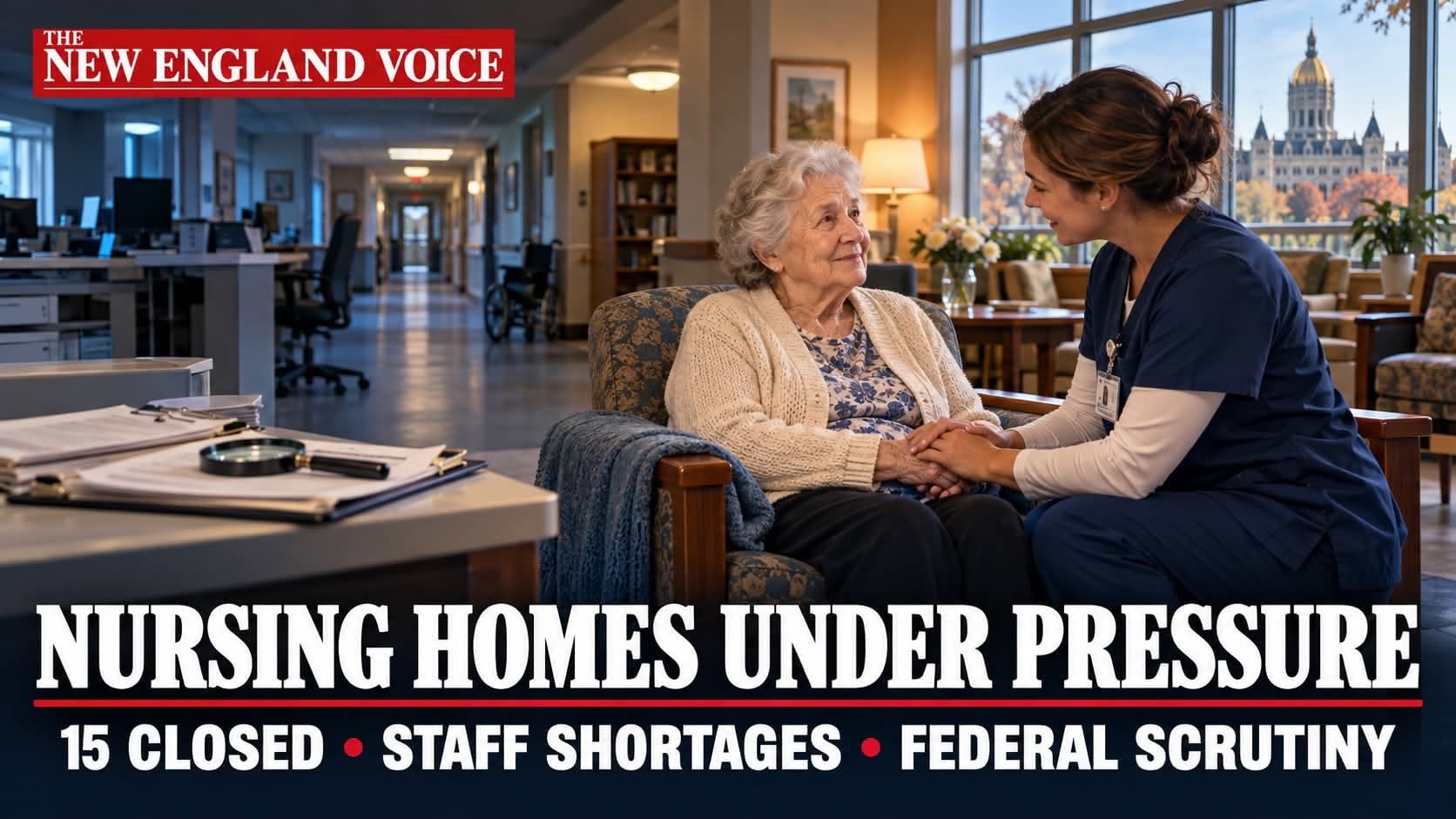
Connecticut Nursing Homes Under Pressure: Closures, Staffing Shortages and Six Facilities Under Federal Scrutiny
Fifteen nursing homes have closed since 2021 as state and federal records document recurring care deficiencies, workforce problems and increased oversight
HARTFORD, Conn. — Connecticut's nursing-home system is operating under growing pressure as facility closures, high occupancy, staffing shortages and repeated care deficiencies raise questions about whether the state is prepared to meet the needs of an aging population.
An official state report says 15 Connecticut nursing homes have closed since 2021 and more than 3,000 licensed beds have been removed. During the same period, statewide nursing-home occupancy increased from approximately 73% to 89%.
The latest federal Special Focus Facility report adds another warning sign. As of September 30, one New Britain nursing home remained under enhanced federal monitoring, while five additional Connecticut facilities appeared on a candidate list reserved for homes with histories of serious quality problems.
These findings do not mean that every Connecticut nursing home is unsafe. They do, however, show a long-term-care system facing significant financial, workforce and quality-control challenges.
Fewer nursing homes and more occupied beds
Connecticut's Nursing Home Financial Advisory Committee reported that the state had 192 licensed nursing-home facilities as of October 1, 2025. Those homes contained 22,168 licensed beds, including 21,543 beds certified for Medicaid.
Approximately 19,142 Medicaid-certified beds were occupied, producing an 88.9% occupancy rate. The self-reported occupancy rate increased to 89.6% by November 2025.
The committee said the rise was partly connected to nursing-home closures. Fifteen facilities have closed since 2021, removing more than 3,000 beds from the system. State officials said they will continue monitoring whether particular regions lose so many beds that residents have difficulty finding appropriate care near their families and communities.
Connecticut has also been working to help more older adults and people with disabilities receive services at home rather than in institutions. Approximately 70% of Medicaid long-term services and supports are now delivered in community settings, while 30% are delivered in institutions. The state's goal is to reach a 75%-to-25% balance by 2028.
That shift may reduce demand for some institutional beds, but the committee emphasized that nursing homes remain essential for people who require around-the-clock skilled care that cannot be provided safely at home.
Staffing shortages continue
The state report identifies staffing as a continuing challenge. Nursing homes have struggled to recruit and retain enough employees, limiting their ability to fill available beds and consistently provide high-quality care.
Financial pressure compounds the problem. Facilities face rising labor, insurance, supply and temporary-staffing costs. Medicaid accounted for approximately 71% of Connecticut nursing-home residents during state fiscal year 2025, making state reimbursement policy especially important to facility finances.
Connecticut joined a federal nursing-home staffing campaign in October 2025 and entered the Interstate Nurse Licensure Compact, which allows eligible nurses to work across participating states using one multistate license. The state says the full effects of those efforts will take several years to measure.
Inspectors repeatedly found problems involving care and safety
The Nursing Home Financial Advisory Committee reviewed the most frequently cited deficiencies during federal fiscal year 2025. Problems appearing repeatedly included:
- Quality of care
- Failure to protect residents from accident hazards or provide adequate supervision
- Services that did not meet professional standards
- Failure to develop or implement comprehensive care plans
- Failure to notify appropriate individuals about changes in a resident's condition
- Abuse-and-neglect protections
- Reporting alleged violations
- Infection prevention and control
The report also said findings classified as Immediate Jeopardy remained steady. Federal regulators use that designation when a facility's noncompliance has caused—or is likely to cause—serious injury, harm, impairment or death.
Immediate Jeopardy findings involving accident hazards, supervision, safety devices and medication errors appeared consistently, according to the state report.
An inspection citation does not by itself establish that every resident experienced harm. Facilities cited for noncompliance are required to submit and implement correction plans, and regulators conduct follow-up oversight.
One Connecticut home remains in the federal Special Focus Facility program
The Centers for Medicare & Medicaid Services updated its Special Focus Facility list on September 30, 2026.
Grandview Rehabilitation and Healthcare Center, located at 55 Grand Street in New Britain, was listed as Connecticut's current Special Focus Facility. CMS reported that the facility had been in the program for 50 months. Its most recent inspection, dated May 14, 2026, did not meet the federal survey criteria required to advance toward graduation from the program.
Special Focus Facilities receive full onsite inspections at least twice annually—approximately twice as frequently as most nursing homes. They may face progressive enforcement, including civil penalties or denial of Medicare payments, until they either demonstrate sustained improvement or are removed from Medicare and Medicaid participation.
CMS explains that homes selected for the program generally have more deficiencies than other facilities, more serious problems and a pattern of problems persisting over several years.
The designation does not mean improvement is impossible. To graduate, a facility must demonstrate sustained progress through consecutive qualifying inspections.
Five more Connecticut facilities are candidates for enhanced oversight
The September CMS report also listed five Connecticut nursing homes as Special Focus Facility candidates:
- Arden Care Center, Hamden
- Bickford Health Care Center, Windsor Locks
- Cobalt Lodge Health Care and Rehabilitation Center, Cobalt
- New London Sub-Acute and Nursing, Waterford
- Noble Horizons, Salisbury
A candidate designation is not the same as formal placement in the Special Focus Facility program. Candidate homes are identified through an inspection-based scoring system that considers the number, severity and scope of deficiencies documented during recent standard and complaint surveys.
CMS selects only a limited number of candidates for enhanced oversight. The federal agency also cautions that reporting delays can occur between an inspection and publication of the results. Families should therefore review the newest available inspection information and speak directly with regulators, residents and facility representatives.
What families can do before choosing a nursing home
Families should not rely on a single star rating, inspection or advertisement. CMS recommends reviewing a facility's health inspections, staffing levels, quality measures and enforcement history through Medicare's Care Compare system.
Families can also:
- Visit the facility more than once and at different times of day
- Ask how many registered nurses and certified nursing assistants are present during each shift
- Review the most recent inspection report and correction plan
- Ask about employee turnover and the use of temporary staffing agencies
- Speak privately with residents and their relatives
- Contact Connecticut's Long-Term Care Ombudsman Program for assistance
- Report care or safety concerns to the Connecticut Department of Public Health
Connecticut DPH accepts complaints concerning licensed health-care facilities at 860-509-7400. The Long-Term Care Ombudsman Program can be reached at 1-866-388-1888.
As Connecticut encourages more care at home, state leaders must still ensure that residents who need skilled institutional services can find a safe bed, properly trained staff and consistent care. The latest state and federal records show that maintaining that balance remains one of Connecticut's most urgent challenges for older adults and their families.
Shifting care toward home and community settings
Connecticut has also been working to help more older adults and people with disabilities receive services at home rather than in institutions. Approximately 70% of Medicaid long-term services and supports are now delivered in community settings, while 30% are delivered in institutions. The state’s goal is to reach a 75%-to-25% balance by 2028.
That shift may reduce demand for some institutional beds, but the committee emphasized that nursing homes remain essential for people who require around-the-clock skilled care that cannot be provided safely at home.
Staffing shortages continue
The state report identifies staffing as a continuing challenge. Nursing homes have struggled to recruit and retain enough employees, limiting their ability to fill available beds and consistently provide high-quality care.
Financial pressure compounds the problem. Facilities face rising labor, insurance, supply and temporary-staffing costs. Medicaid accounted for approximately 71% of Connecticut nursing-home residents during state fiscal year 2025, making state reimbursement policy especially important to facility finances.
Connecticut joined a federal nursing-home staffing campaign in October 2025 and entered the Interstate Nurse Licensure Compact, which allows eligible nurses to work across participating states using one multistate license. The state says the full effects of those efforts will take several years to measure.
Inspectors repeatedly found problems involving care and safety
The Nursing Home Financial Advisory Committee reviewed the most frequently cited deficiencies during federal fiscal year 2025. Problems appearing repeatedly included:
- Quality of care
- Failure to protect residents from accident hazards or provide adequate supervision
- Services that did not meet professional standards
- Failure to develop or implement comprehensive care plans
- Failure to notify appropriate individuals about changes in a resident’s condition
- Abuse-and-neglect protections
- Reporting alleged violations
- Infection prevention and control
The report also said findings classified as Immediate Jeopardy remained steady. Federal regulators use that designation when a facility’s noncompliance has caused—or is likely to cause—serious injury, harm, impairment or death.
Immediate Jeopardy findings involving accident hazards, supervision, safety devices and medication errors appeared consistently, according to the state report.
An inspection citation does not by itself establish that every resident experienced harm. Facilities cited for noncompliance are required to submit and implement correction plans, and regulators conduct follow-up oversight.
One Connecticut home remains in the federal Special Focus Facility program
The Centers for Medicare & Medicaid Services updated its Special Focus Facility list on September 30, 2026.
Grandview Rehabilitation and Healthcare Center, located at 55 Grand Street in New Britain, was listed as Connecticut’s current Special Focus Facility. CMS reported that the facility had been in the program for 50 months. Its most recent inspection, dated May 14, 2026, did not meet the federal survey criteria required to advance toward graduation from the program.
Special Focus Facilities receive full onsite inspections at least twice annually—approximately twice as frequently as most nursing homes. They may face progressive enforcement, including civil penalties or denial of Medicare payments, until they either demonstrate sustained improvement or are removed from Medicare and Medicaid participation.
CMS explains that homes selected for the program generally have more deficiencies than other facilities, more serious problems and a pattern of problems persisting over several years.
The designation does not mean improvement is impossible. To graduate, a facility must demonstrate sustained progress through consecutive qualifying inspections.
Five more Connecticut facilities are candidates for enhanced oversight
The September CMS report also listed five Connecticut nursing homes as Special Focus Facility candidates:
- Arden Care Center, Hamden
- Bickford Health Care Center, Windsor Locks
- Cobalt Lodge Health Care and Rehabilitation Center, Cobalt
- New London Sub-Acute and Nursing, Waterford
- Noble Horizons, Salisbury
What the candidate designation means
A candidate designation is not the same as formal placement in the Special Focus Facility program. Candidate homes are identified through an inspection-based scoring system that considers the number, severity and scope of deficiencies documented during recent standard and complaint surveys.
CMS selects only a limited number of candidates for enhanced oversight. The federal agency also cautions that reporting delays can occur between an inspection and publication of the results. Families should therefore review the newest available inspection information and speak directly with regulators, residents and facility representatives.
What families can do before choosing a nursing home
Families should not rely on a single star rating, inspection or advertisement. CMS recommends reviewing a facility’s health inspections, staffing levels, quality measures and enforcement history through Medicare’s Care Compare system.
Families can also:
- Visit the facility more than once and at different times of day
- Ask how many registered nurses and certified nursing assistants are present during each shift
- Review the most recent inspection report and correction plan
- Ask about employee turnover and the use of temporary staffing agencies
- Speak privately with residents and their relatives
- Contact Connecticut’s Long-Term Care Ombudsman Program for assistance
- Report care or safety concerns to the Connecticut Department of Public Health
Connecticut DPH accepts complaints concerning licensed health-care facilities at 860-509-7400. The Long-Term Care Ombudsman Program can be reached at 1-866-388-1888.
As Connecticut encourages more care at home, state leaders must still ensure that residents who need skilled institutional services can find a safe bed, properly trained staff and consistent care. The latest state and federal records show that maintaining that balance remains one of Connecticut’s most urgent challenges for older adults and their families.
Official sources
- Connecticut Nursing Home Financial Advisory Committee: 2026 Annual Report
- CMS Special Focus Facility Program List — Updated September 30, 2026
- Connecticut DPH: Nursing Home Inspections
- Connecticut Attorney General: Nursing Home Information and Complaints
- CMS Five-Star Quality Rating System
Editor’s note: Facility designations and inspection information reflect the cited official reports and may change as new inspections are completed. A candidate designation is not the same as placement in the Special Focus Facility program.