
Democrats Lead Connecticut’s Early Turnout. What Does That Tell Us?
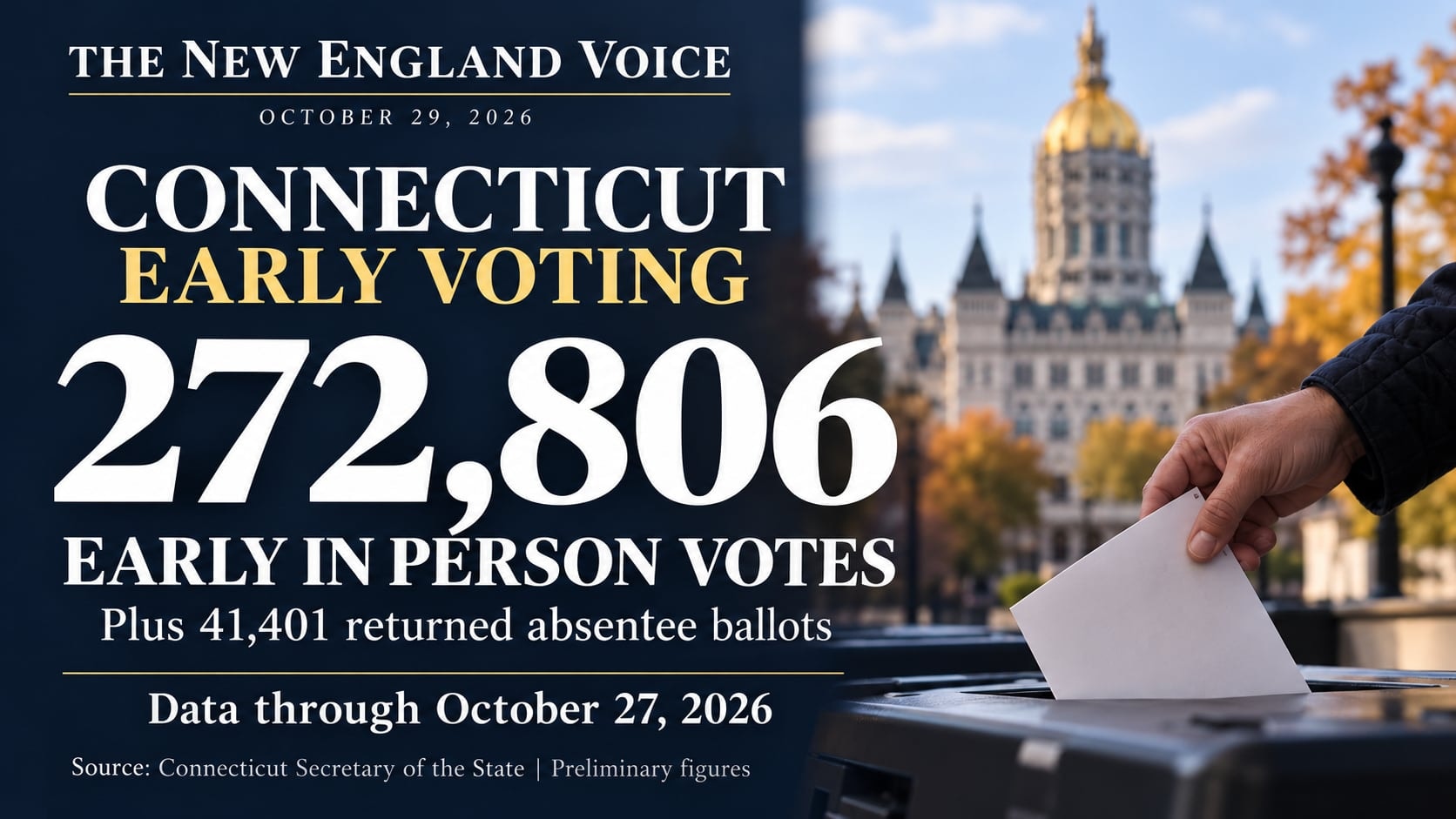
314,207 ballots cast through October 27. Democrats lead early participation — but party registration does not reveal candidate choices, and Republicans historically vote later.
More registered Democrats than Republicans have already voted in Connecticut. The gap is substantial, but for anyone following the governor’s race, those numbers come with an important question: How much do they tell us about who will win?
They show who has participated so far. They do not reveal which candidates those voters supported, or how many people will turn out on Election Day.
According to the Connecticut Secretary of the State’s report covering voting through October 27, voters had cast 314,207 ballots through early in-person voting and returned absentee ballots. That total included 159,680 registered Democrats, 58,073 Republicans, 92,367 unaffiliated voters and 4,087 voters registered with other parties. The figures are preliminary and subject to change.
The Democratic lead in participation deserves attention. But understanding it requires looking at when voters from each party typically cast their ballots.
A national Gallup survey published October 29 found that 54 percent of registered Democrats had already voted or planned to vote before Election Day, compared with 38 percent of Republicans and 37 percent of independents. Conducted October 1 through 19, the survey measures voting intentions across the country, rather than turnout or preferences specifically in Connecticut.
Those findings help explain why an early participation report can look more Democratic than the electorate that eventually votes. In recent elections, Republicans have been more likely than Democrats to wait until Election Day.
Still, describing that pattern as something that has always happened would go too far. Gallup reports that before 2020, Republicans and Democrats were about equally likely to say they would vote early. Voting habits have changed, and they can change again.
Early in-person and mail voting attract different voters
There is another distinction that can get lost in the discussion: Voting early in person and voting by mail do not necessarily attract the same mix of voters.
Pew Research Center’s survey following the 2024 election found that 39 percent of Republican voters reported voting in person on Election Day, compared with 28 percent of Democratic voters. Democrats were considerably more likely to report using mail or absentee ballots, at 44 percent, compared with 26 percent of Republicans.
But Republicans reported a higher rate of early in-person voting: 35 percent, compared with 28 percent among Democrats. That finding complicates the familiar claim that Democrats vote early while Republicans vote late. The method matters, as does the election being examined.
What the numbers cannot tell us about Lamont and Fazio
For Connecticut readers watching Ned Lamont and Ryan Fazio, the practical implication is straightforward. A ballot cast by a registered Democrat cannot automatically be counted as a vote for Lamont. A ballot cast by a registered Republican cannot automatically be counted as a vote for Fazio. Party registration is public information. A voter’s choices remain private.
Nor does the Republican tendency to vote on Election Day guarantee that the party will make up the current participation gap. That will depend on how many additional voters participate and which candidates they choose.
Unaffiliated voters: the largest unknown
Unaffiliated voters are another important part of the picture. More than 92,000 had participated through October 27, combining early in-person voting and returned absentee ballots. The state reports them separately from voters registered with other parties. Those figures provide no indication of which candidates they supported.
Being unaffiliated does not mean sharing a single political outlook. Their ballots cannot be assigned as a group to either side.
Early turnout reports are useful because they show participation as it develops. They can identify differences in when groups of voters are casting their ballots. But without knowing the choices on those ballots, or the turnout still to come, they offer an incomplete view of the election.
Connecticut’s Democratic voters have established a clear lead in participation so far. Whether that becomes a victory for their candidates will depend on the full electorate, including the people who have yet to walk into a voting location.
Sources
- Connecticut Secretary of the State — Early voting and absentee ballot data through October 27, 2026
- Gallup — National survey on early voting intentions, October 1–19, 2026
- Pew Research Center — How Americans voted in the 2024 election
Isabel Calione
Founder and Editor, The New England Voice. Author and community journalist covering Connecticut and New England.