
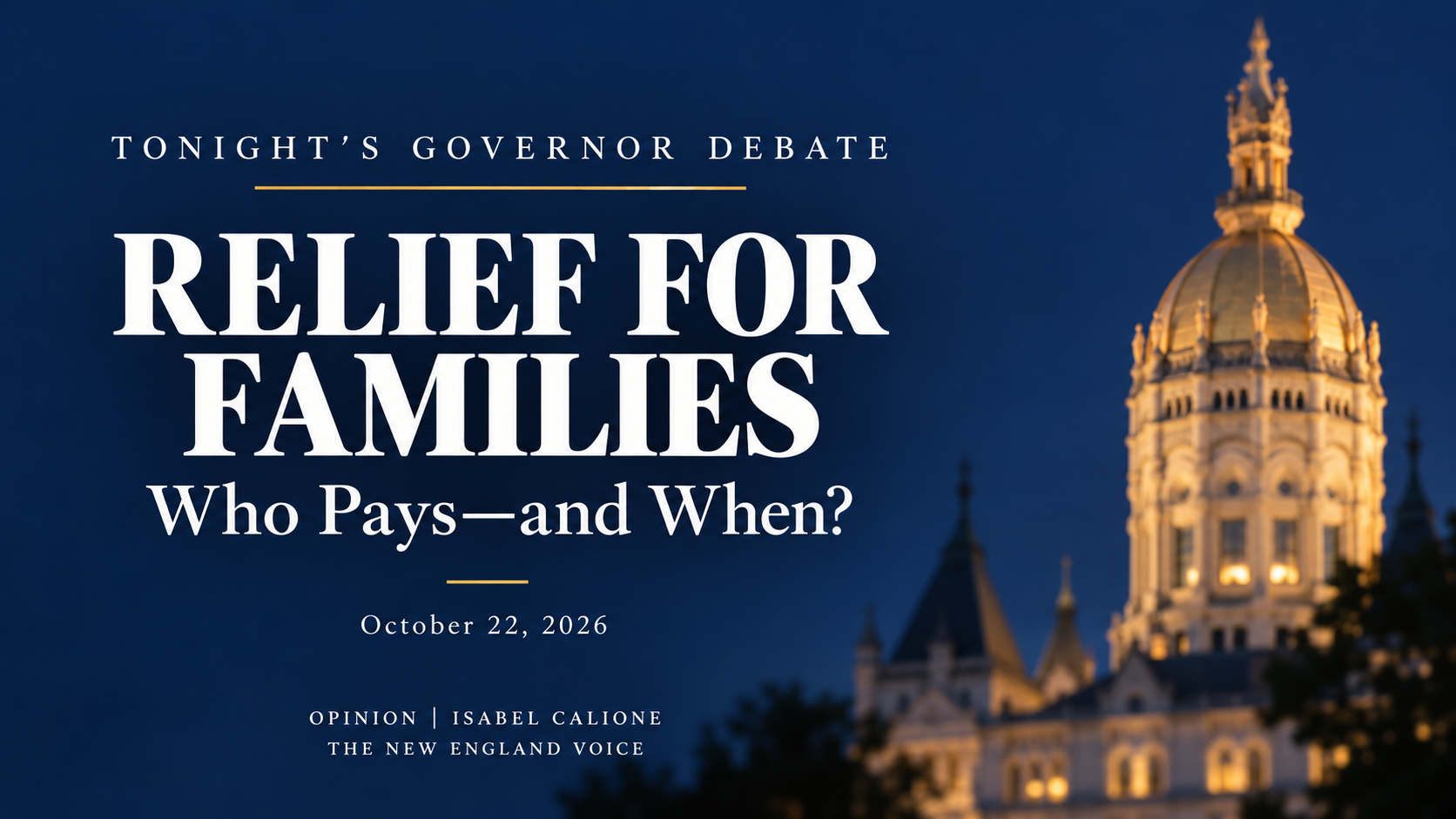
Connecticut Families Need Relief. What Are the State's Priorities?
Reflections on the October 22, 2026, gubernatorial debate
By Isabel Calione
· The New England Voice
After watching tonight's debate between Governor Ned Lamont and Senator Ryan Fazio, I was left with one central question: When Connecticut families are struggling, what should our state government prioritize?
The debate raised a question that reaches beyond campaign promises: When Connecticut families are struggling, what should government prioritize?
Fazio has proposed temporarily suspending Connecticut's 25-cent-per-gallon gasoline tax. Lamont has questioned the financial consequences of temporary tax relief. Asking how a proposal would be funded is reasonable. But taxpayers deserve equally demanding questions about how government spends and protects the money it already collects.
Fazio has offered a funding explanation: he pointed to a projected Special Transportation Fund balance of roughly $600 million and estimated his proposal would cost slightly more than $100 million. Those are his estimates — and his commitments.
The question is therefore about priorities: What relief can Connecticut responsibly provide, and what spending decisions would make it possible?
A Record That Demands Scrutiny
Connecticut's record provides reasons to demand stronger oversight. In the West Haven case, former state representative and city employee Michael DiMassa admitted participating in schemes involving the theft of more than $1.2 million in COVID-relief money and other municipal funds. Federal authorities documented payments for goods and services that were never provided.
That money was intended to support a community during an emergency. Its theft represents a failure to protect resources meant to serve the public.
The case does not establish personal wrongdoing by Governor Lamont, and stolen federal or municipal funds cannot simply be counted as available state revenue. But it illustrates why preventing fraud and recovering misused money must be part of the conversation about affordability.
Families are expected to account for every dollar. Government should face the same expectation. When officials question the cost of temporary relief, taxpayers have every right to ask what is being done to prevent losses, scrutinize contracts, and reduce unnecessary spending.
Electricity Relief — and Its Limits
Electricity relief raises a related concern. On September 8, Connecticut approved $145 million in additional state borrowing to continue moving certain public benefits costs off electricity bills. The governor's office says that financing reduces average residential bills by approximately 3–5 percent.
That help matters. But borrowing also creates repayment obligations. Other electricity savings have come from nuclear contracts and lower supply rates; the portion financed through debt shifts costs into the future.
The Questions Families Deserve Answered
As the holiday season approaches, Connecticut families deserve clear answers:
- What relief is possible now?
- What lower-priority spending could be reduced without harming essential services?
- How much misused money has been recovered?
- How will officials prevent further losses?
Protecting public money and helping struggling families should be connected priorities.
When Connecticut promises affordability, voters deserve to know whether the total cost is falling — or whether the bill is simply moving elsewhere.
Isabel Calione
Founder and editor of The New England Voice. Isabel covers Connecticut politics, accountability, and community affairs.